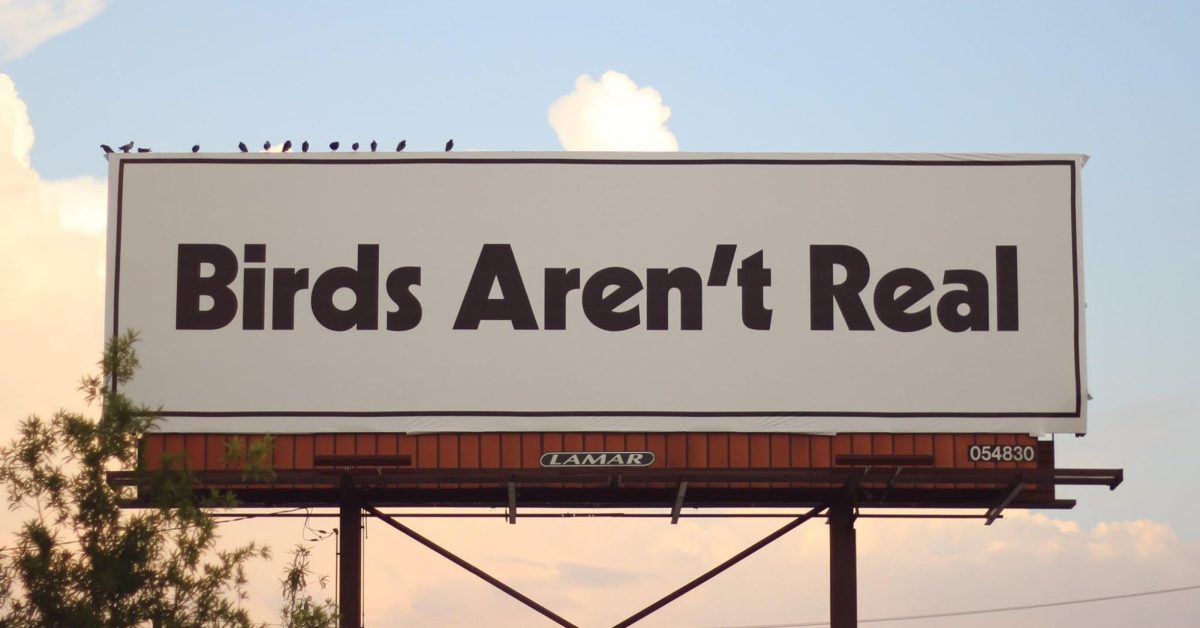
The next time you’re eating lunch in the park and a pigeon is closer than usual, take a look at its eyes. Is that a glimmer of curiosity, or is it a lens capturing your every move? For a number of people, the answer is clear. The sky is no longer filled with wildlife, but with government hardware. This is the core belief of “Birds Aren’t Real,” a movement that has transformed from an internet meme into a massive cultural phenomenon.
The conspiracy alleges a dark history that supposedly began in the mid-20th century. According to the movement’s lore, the United States government grew tired of the mess and unpredictability of actual birds. Between 1959 and 2001, the theory claims the government systematically phased out every living bird in North America, replacing them with millions of feathered drones. These high tech replicas were designed to monitor the American public from the best vantage point possible, the air.
This “how” of the conspiracy is where the details get creative. The reality of the conspiracy points to power lines as the ultimate evidence, claiming that birds don’t sit on them to rest, but to charge their internal batteries. They suggest that bird droppings are actually a tracking liquid used to mark targets from above. Even the “when” is specific, the movement claims the final biological bird died in 2001. Right around the time surveillance technology took a massive leap forward.
However, the real story behind the movement is one of social commentary rather than actual secrets. Founded in 2017 by Peter McIndoe in Fayetteville, Arkansas. The project began as a spontaneous piece of art. McIndoe noticed a protest and decided to join with a sign featuring the most absurd statement he could think of. To his surprise, the idea resonated. It quickly spread across college campuses and social media platforms like TikTok, where young people adopted the persona of “Bird Brigade” members to highlight the absurdity of the “post-truth” era.
While the idea of a robotic sparrow might seem like a joke, it serves a serious purpose for students and journalists alike. By mimicking the language and structure of actual conspiracy theories, “Birds Aren’t Real” acts as a masterclass in media literacy. It shows how easily misinformation can be packaged to look official and how a community can form around a shared, fictional narrative. In an age where it is increasingly difficult to separate fact from fiction, the movement serves as a reminder to always check the source before you believe the story.