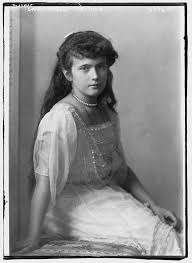
A dark basement was where she and her family were kept. A dark basement was where she last slept, and yet, people around the world all thought she lived. Her story was made into a movie, then a musical performed on Broadway. Her story has been used in books and is discussed throughout the 1900s, but what really happened to Grand Duchess Anastasia?
The youngest daughter of Tsar Nicholas II and Tsarina Alexandra Feodorovna, Grand Duchess Anastasia Nikolaevna, was the center of attention. Rumors spread about the possibility of her escaping the fated doom that her family endured. But these rumors were disproven in 1976, when the remains of Anastasia and her family were found by Russian scientists.
Anastasia was born on June 18, 1901, in Peterhof, Russia. She was raised with her three sisters, Grand Duchess Maria, Grand Duchess Tatiana, Grand Duchess Olga, and her younger brother Alexei. Anastasia and her sisters were known as OTMA, and they were very close to each other. During WWI, Olga and Tatiana went to work as Red Cross nurses, and although considered too young to work as nurses, Anastasia and Maria visited wounded soldiers to raise morale.
In 1917, the Romanov family was taken into custody during the 1917 Russian Revolution. They were placed under house arrest at the Alexander Palace in Tsarskoye Selo after her father abdicated from the throne. In June 1918, civil war broke out, and the family was relocated. A death sentence was later passed on the imperial family after a secret meeting of the Yekaterinburg Soviet.
Anastasia was assassinated on July 16 or 17, 1918, at Ipatiev House in Russia, at 17 years old. There is no exact date, but evidence is in favor of the latter. Her family was ordered to dress quickly and go down to the cellar at the house they were staying at. They were told to take a picture to squelch rumors that they had escaped. Instead of a picture, dozens of men busted and shot down the imperial family. Those who were still breathing after the smoke cleared were stabbed to death.
When the remains of Nicholar, Alexandra, and Anastasia’s older sisters were found, speculation fueled the public that the young heir and Grand Duchess might have survived the execution. Many started to pretend to be Grand Duchess Anastasia, including a woman called Anna Anderson, who turned out to be Franziska Schanzkowska. Another pretender was a suicidal young woman who was admitted to the Dalldorf Asylum. She wouldn’t tell anyone her identity, and the public assumed that she could only be Anastasia. There were many others who claimed to be the Grand Duchess.
The rumor that Anastasia survived was more than enough to create fictional interpretations of her story. The biggest one is the 1997 film Anastasia from 20th Century Studios. The story is based on Anastasia’s life, but turns to magic and music. Anastasia escapes the death that befalls her family when she was young with her grandma, with the help of a young servant boy, Dimitri. However, she wasn’t able to get on the train with her grandmother and had amnesia. At age 18, she is sent out on her own from the orphanage to get to Paris with the help of Dimitri and Vald. Throughout the film, songs are sung, and Anastia is chased by a villain, Lenin, until the climax, where she defeats Lenin and reunites with her love, Dimitri. The film isn’t the only historical fiction based on Anastasia’s story. I Was Anastasia by Ariel Lawhon, Romanovby Nadine Brandes, and The Last Grand Duchess by Carolyn Meyer.