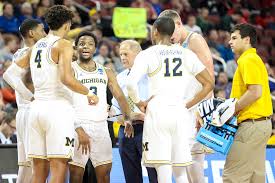
After a 37-3 regular season, Michigan entered the NCAA Tournament, known as March Madness, as a No. 1 seed. 14.19% of people selected Michigan to take home the championship. On April 6th, 2026, Michigan took home its second-ever title since 1984. Let’s look at the roadmap they took to get there.
Michigan v. Howard – First Round
Michigan was able to keep the lead throughout the entire game, with Howard closely trailing behind. By the first half, Michigan was up 50-46, and Michigan ended the game 101-80. Morez
Johnson Jr, the forward for Michigan, had a perfect shooting night, dropping twenty-one points and getting ten defensive rebounds. Michigan ended the game making 67% of their field goals, 46% of their three pointers, and 80% of their free throws.
Michigan v. Saint Louis – Second Round
Throughout the first half, it was a very close game with both teams scoring points back and forth. But before halftime, Michigan built a lead of nine, with a score of 48-39. During the second half, Saint Louis was able to make a bit of a comeback and kept the game close, but once Michigan pulled away with over a ten-point lead, it was game over for Saint Louis. The game ended with a final score of 95-72. Michigan made 56% of its field goals, 48% of its three-pointers, and 70% of its free throws. Yaxel Lendeborg, a forward for Michigan, was a key offensive force in this game. Yaxel made nine field goals, three three-pointers, and 4 free throws, totaling a solid twenty-five points.
Michigan v. Alabama – Sweet 16
The first half of this game was mainly Michigan trailing behind Alabama by around 4 points, but once the second half started, the momentum shifted. Michigan dominated the second half; at one point, they had a sixteen-point lead. Yaxel Lendeborg, their key star, dropped twenty-three points against Alabama, making fifteen out of twenty-one of his shots. Both Elliot Cadeau and Trey McKenney ended with seventeen points. Michigan ended the game 90-77, making 50% of their field goals, 48% of their three-pointers, and 55% of their free throws.
Michigan v. Tennessee – Elite 8
Michigan dominated the entire game against Tennessee; by the time the second half started, the game was already over for Tennessee. Tennessee made 5 out of their twenty-six attempted three-pointers, and twenty-four out of seventy-six field goals. Lendeborg continued to show the valuable asset he was to the team by putting twenty-seven points on the board for Michigan. Michigan won 95-62. Michigan made 52% of its field goals, 37% of its three-pointers, and 73% of its free throws.
Michigan v. Arizona – Final Four
This game was a huge upset for fans and brackets, but yet again, Michigan proved to be a dominant force. Arizona couldn’t keep up with Michigan’s extreme offense. Michigan kept the lead the entire game. Aday Mara, the center for Michigan, was the star of this game. Mara was consistently hitting layups left and right, giving the team 26 points; he was unstoppable. He led his team to victory, winning 91-73. Michigan made 48% of its field goals, 44% of its three-pointers, and 81% of its field goals. Overall, Michigan dominated the game.
Michigan v. Uconn – National Championship
This was the first time Michigan had been in the championship in eight years. This was an insane close game, the closest out of all the ones Michigan had played, but Michigan was still able to keep steady control of the game throughout its entire duration. On paper, it seemed as if Michigan should’ve lost the game; the offense wasn’t fully there, but the defense made up for it. Elliot Cadeau, a guard for Michigan, really helped the offense by scoring nineteen points. But in the end, Michigan held off UConn’s offense and won the championship. It was the first time they had won a championship in over 35 years. The last time being in 1989 against Seton Hall. In the end, Michigan made 38% of its field goals, 13% of its three-pointers, and 89% of its free throws.